
What is self-publishing?
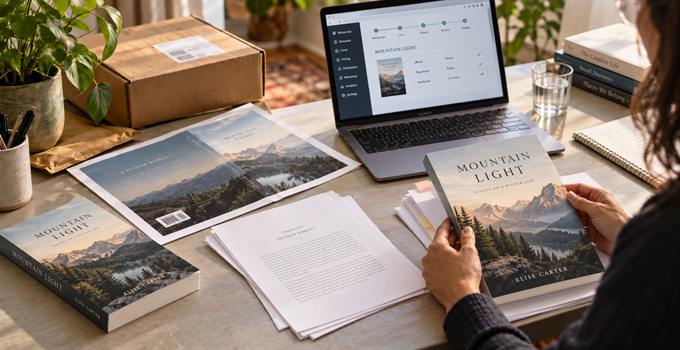
Self-publishing means that you are in charge of bringing your book to market. You decide how it's produced, who works on it, when it's published, where it is sold. But that does not mean doing every job by yourself. A self-published author will typically hire an editor, cover designer, book formatter and often a company to support them through the publishing process.
"Getting published," traditionally, has long been an odd mix of talent and luck. Writers must hope they have the talent, but also that publishers will recognize their potential and give their book a chance. And for every book on a bookshop shelf, there were dozens more rejected and resigned to desk drawers. That was until publishing changed. Now, since the growth of the indie and self-publishing movement, authors have options. A book deal is no longer your only option. You can choose to step away from traditional publishing if you want to and try a different way.
This new freedom to shape our own quality publishing routes without relying entirely on a lucky break is exciting. However, that doesn't mean it's risk free or easy. It's really important to appreciate what each different publishing option means. Let's break down your choices, so you know the path you're about to walk along.
How traditional publishing works
Until self-publishing, this was the only way. You or your agent send your manuscript off to publisher after publisher in the hope that whoever reads it will love it and want to publish it. Nobody, however talented, is guaranteed a book deal. It will always be something of a gamble. You may need to face rejection after rejection which can be both exhausting and bruising. However, the hope is that you'll eventually hear those magic words: "We'd like to offer you a book deal."
If you accept the publisher's offer, they'll acquire the publishing rights to your book and may pay you an advance. They'll steer the edits or rewrites, arrange the cover and layout, sort out printing and get the book into the trade. But you typically won't get final approval over things like the cover or layout. It's also an incredibly slow process. Even after you've finished the book, it can take years to find an agent, get a deal and finally reach publication. That's a real problem if your book is topical and you want to get it in front of people quickly.
And then there's the marketing. This is a funny one. You can find you have little say here, yet still be expected to do a surprising amount of promotion yourself. Then once your book starts selling, your royalties first go towards earning back that advance.
Self-publishing is ideal when you already know your market
If you already have access to a keen audience, intend to focus on a niche market or have some of your own great book marketing ideas then in many cases self-publishing can now offer even more than a traditional route can. You may already have a direct way to reach readers through your website, business, church or speaking engagements. If you know where your readers are, you don't necessarily need a publisher to find them for you.
Self-publishing is also much, much quicker than traditional publishing. Once your book is ready to publish, you can start selling in lightning quick time. And because you retain ownership of your book, you'll be able to keep a much higher share of what it earns.
But of course, making a book available and finding its readers are not the same job. You can get your book onto Amazon, into online stores and out into the wider book trade, but none of that guarantees anyone will discover it. This is where already having your own audience or route to market can make such a difference.
Print on demand made self-publishing so much easier
Print on demand means when a copy of your book is sold, it is printed, bound and shipped to fulfil the order. This modern method of printing is a superb option for self-publishers. It completely removes the need for any big upfront investment. There is no need for a large initial print run or to pay warehousing costs. Instead, each time a book is ordered, it is simply printed and shipped to the buyer, how clever is that!
That took away one of the biggest barriers to self-publishing. Authors no longer needed a big pot of money for an initial print run, or somewhere to keep hundreds of books while they waited for them to sell. Publishing your own book suddenly became possible on a completely different scale.
A self-published book should look just as professional
In the past, there has been some stigma around self-published books and indie authors. Self-publishing was seen to remove the input of experts and replace it with a "have a go" mentality. And to be honest, in the beginning, some authors did use self-publishing in this way. Many tried to do everything themselves, from editing to book design, usually without the proper experience, skill, or software to do things properly.
The good news is that self-publishing has moved swiftly past these rocky beginnings. Authors and service providers are, for the most part, choosing to put professional excellence and quality first, rather than chase a cheap, quick result. A good quality self-published book always reflects the quality of the decisions that came before it.
The publishing machinery gets surprisingly involved
It is perfectly possible to learn the technical side yourself, but there is more to it than uploading a PDF. The cover and interior have to meet the specifications of the printer and platform being used. ISBNs and metadata need setting up, prices need deciding, files go through technical checks and proofs need reviewing. Amazon, Ingram and ebook platforms don't all work in exactly the same way either.
Small changes can then have knock-on effects. A paperback might be completely ready to publish, then a late edit adds twenty pages. The spine is now wider, which means the cover template changes too. Suddenly a cover that was ready to print needs adjusting before it can be uploaded again.
Self-publishing requires a high level of commitment: think of it as a new, serious, all consuming hobby. Just because the process can be super quick, doesn't mean you should be doing everything as quickly as possible. The prep will take a lot of time, too. You'll need to study up on blogs and books to fill in gaps in your knowledge before you make decisions, and source help for each stage.
Self-publishing means you're in charge, but not in charge of every job
By choosing the DIY self-publishing path, you take on the role of project manager for your book. You guide it through editing, design, publishing, marketing and distribution.
It can seem like an overwhelming amount of work. Having this much control just comes with a catch. There is no safety net. You'll be fully accountable for everything, often in a world where you have no experience. Just don't be tempted to skip, rush or fudge the stages.
This could be your chance to make your book your own, but still do it right. And if you source and hire help at each stage, it doesn't need to be that difficult. We provide an all-inclusive supported self-publishing service to make things as easy as possible. Rather than buying separate bits of help from all over the place, you just stick with us as a single company. One contact to help manage your project and answer questions from start to finish.
So, is self-publishing right for you?
Picking the right publishing route is a big decision. You'll need to think carefully about your goals, your book, your skills, your lifestyle, and your personality. Be honest with yourself. Are you willing or able to take on a time consuming new hobby and learn new skills? Or do you need a helping hand to get your book out there looking its best?
Nowadays, self-publishing doesn't have to mean making a book entirely on your own. The important part is that you choose the route and remain in control of your book. But you can leave the rest to the experts.