
What is book formatting?
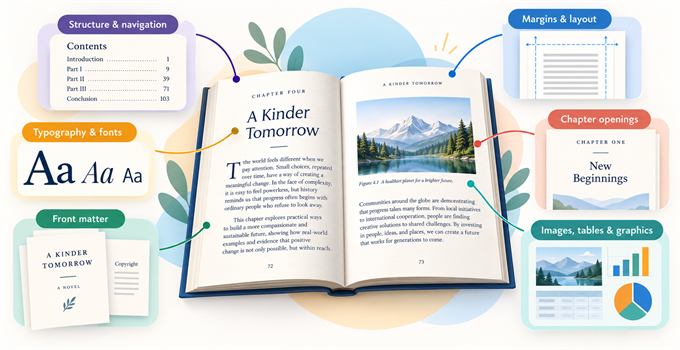
Book formatting, or typesetting, means taking a manuscript and turning it into an actual book. We love books. We love reading books and we love designing books; searching to find that perfect combination of type and layout that will really bring the pages to life.
For a novel it's about typesetting text in a carefully chosen, high quality typeface. A technical book needs the structure clearly presented with strong, intuitive navigation. For an illustrated book you want the content to flow, images and words weaving together seamlessly.
Whatever the book, our job as designers is to help you, the author, communicate your ideas and tell your story. We do this by considering the conventions of good book design and the science of comfortable reading, combined with our extensive knowledge of what really works in print.
It starts with the manuscript
First we review the files, confirming receipt of all the text, images, styling requests and print specs. Chapters and other material are compiled into a single source file to work from, and the text is prepped. That means removing unwanted spaces, breaks, tabs and sections, along with stray paragraph marks, soft hyphens and page breaks that have crept in over time.
Sometimes the manuscript we receive is tidy. Sometimes it really isn't. Headings can be styled in half a dozen different ways. Repeated spaces may have been used to position text. Images may be embedded at wildly different qualities. We have even found text accidentally set in white so nobody knew it was there. At this stage we just need to work out what everything is, where it belongs and how the author intended all the pieces to relate to one another.
Formatting is about layout
Typesetting is about setting your type, not changing the contents. We may make a few amendments to ensure text is consistent, like casing headings consistently, ensuring no spaces before periods, giving opening quote marks matching closed quote marks, ensuring all sentences end with punctuation and all punctuation is followed by a single space.
And if you have used underlining or bold type in ordinary sentences we will swap this for italics in line with standard typesetting practice. But ideally any more substantial editing will have been finished before formatting begins. Small corrections later are normal, but bigger adjustments can have a knock on effect through the whole book.
Then the book starts taking shape
The page is set up with the right trim, margins, binding edge, bleed and recto and verso pages. Parts, chapters, sections and numbering schemes are marked up, and the front matter is styled, including things such as the half title, title, copyright, contents, dedication and foreword.
Sometimes the page setup itself solves a problem. We once received an extremely dense technical manuscript intended for a wide US Letter page. Running the text straight across that width would have created very long lines that were difficult to read. Making the type larger would have solved the line length but pushed the book well beyond the page count the author needed.
A two column layout solved both problems. The lines became comfortable to read, the material fitted efficiently, diagrams could span both columns where needed, and notes could use the space around them. Nothing was wrong with the manuscript. The problem only appeared when we considered how that material would actually behave as a page.
Styling the main body
Then there is the main body styling itself. Fonts and styles are selected for headings, body text, quotes, lists and captions. Running headers may display the author, chapter or book title, while pagination uses Roman or Arabic numbering as appropriate for the front matter and main body.
We often work on business material that has come from academic sources and looked very much like a thesis, with dense, traditional serif fonts. But it was actually about modern, forward-looking business ideas. So the layout became more open, the typography cleaner and more contemporary, and the whole thing suddenly really presented the ideas it contained.
One bilingual project arrived with two languages placed side by side. Because they used similar character sets, it was not immediately obvious which language was which. Using different typefaces made the pages look unnecessarily messy, so we kept the typography consistent and gave each language its own color. The distinction became immediate without extra labels, and those colors could then be used throughout the cover, illustrations and other elements as a visual key. When more books were added to the series, additional languages could simply be given their own colors. The author had originally planned to print in grayscale. In this case, color stopped being decorative and became part of how the book communicated.
Text is now typeset line by line, adjusting spacing, hyphenation, tracking and kerning where necessary. Some books also need distinct styles for call outs, quotations, poetry, letters, dialogue or exercises.
What happens to tables, images and references
Tables need a consistent set of styles so that the information remains clear. A simple table may only need tidying up, but complicated ones often have to be rebuilt completely so they fit the page and remain easy to follow. Column widths, headings, rules, spacing and alignment all need to work together, especially when a table contains a lot of information or runs over more than one page.
Images may need their color model, resolution or saturation correcting before they are touched up, extended or adjusted, then sized, cropped and wrapped to sit with the text. Captions, figures, tables, charts and diagrams all need to stay correctly numbered and cross referenced.
Footnotes and endnotes need a consistently styled set of references linked to each instance. Contents pages have to be generated and styled, along with any lists of figures or tables. An index may need flowing into a multi column layout with the right indent and spacing. There really is quite a lot going on before anybody gets to the finished PDF.
Balancing the pages
The aim here is to make pages look neatly lined up and consistently dense with text. This involves a trade-off between avoiding widows and orphans (a lonely line of text at the top or bottom of a page), ensuring the pages are evened to similar lengths, avoiding large areas of empty white space, and preventing awkward splits in lists or tables.
All these tiny decisions add up. Most readers will never consciously notice that a heading has been kept with the paragraph below it or that a troublesome line has been persuaded back onto the previous page. But they will absolutely notice when the page looks awkward. And we just don't want them distracted away from your content.
A small change travels a long way
Once all those pages have been carefully balanced, even a small change can start knocking things out again. A book should always be handled as one consistently flowing document rather than hundreds of completely separate pages. Tweak a bit of text on page 30, lengthen things by a few words and all the text after it may move. That shifts an image on page 31, which in turn moves a heading on page 32, potentially even rippling through to tip the final line of the chapter onto an extra page.
Last minute changes can mean stacks more work than the size of the edit itself might suggest, because those carefully balanced pages may need working through again. Add enough new pages and even the spine width may change, which means the entire cover template needs adjusting too.
Finally, it has to print properly
Once all the pages are settled, we carry out final preflight checks. We know full well from years of experience that a book can look absolutely perfect on screen yet still cause problems when it reaches the printer! So this is the time for the hidden adjustments, margins amended to allow for binding, images tweaked to improve ink levels, bleed extended where needed, and fonts and colors properly embedded as information in the press-ready PDF.
By this stage the manuscript has been through a lot. And every book brings a different set of puzzles to solve. Sometimes it is a question of choosing a beautiful typeface and making a novel effortless to read. Sometimes there are hundreds of photographs, complicated tables or several levels of headings to wrestle into shape. And sometimes the answer is something the author had never considered, like turning one very wide page into two columns or using color to tell two languages apart.
Working those puzzles out, so the finished pages feel effortless and the reader never has to think about them, is exactly what we love doing. We have been formatting books for authors and publishers for more than twenty years. So if your manuscript is reaching that stage, you can see how we work and what is included in our book formatting services.