
What is an ISBN?
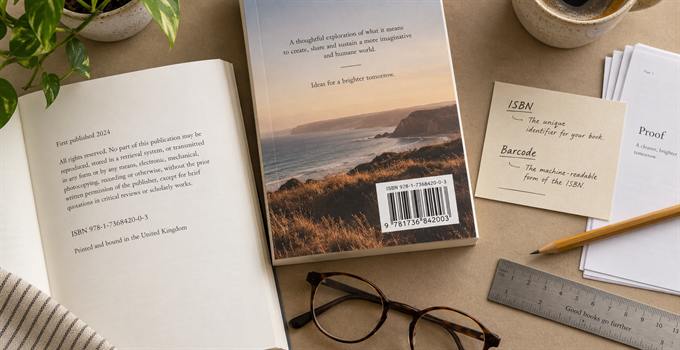
ISBN stands for International Standard Book Number. It is a 13-digit number assigned to every edition and format of a particular book. Using an ISBN rather than just the title means everyone involved can be in no doubt about exactly which book you mean.
An ISBN has nothing to do with who owns the copyright. It identifies the book, not the owner of the material. The 13 digits aren't random either. Different parts identify things like the registration group, the publisher and the book itself, with the final digit used to check that the number is valid.
Say somebody tells you they are looking for a book called Contact. Is it a science fiction novel? A history of martial arts? Maybe the biography of a rugby player? With only so many words in the English language, very different books often end up sharing the same title.
Even knowing the title and the author doesn't narrow things down. Take Harry Potter and the Philosopher's Stone. There's a standard paperback, a large print hardback, a fully illustrated hardback, and a range of special House editions. Two people could be discussing the book. One refers to illustrations in his edition that the other never saw. Complete confusion. Same title, same author, different ISBN.
In a printed book, you'll find the ISBN in at least a couple of places. On the copyright page, amongst the credits, disclaimers and other information, will typically sit a few ISBNs. These will include the book you're actually reading as well as other editions and formats. Then if you flip the book over, you'll also find it buried in the barcode.
An ISBN is not a barcode
The two are very closely related, but they're not the same thing. An ISBN is a 13-digit number assigned to each version of your book. Those digits are then used to create a series of black lines, a scannable image version of the ISBN, known as a barcode.
So, instead of a bookseller having to type in 13 separate digits, they can simply scan the barcode and read the ISBN all in one go. Barcodes don't all look the same. They can vary in height and width, and sometimes include extra information such as the price. What they do have in common is that they need to be generated to the right specification so a barcode scanner can read them properly.
When we work on your cover, you don't need to send us a barcode. In fact, a little low resolution JPEG or screenshot isn't very useful. Just provide your ISBN and let us generate the most fitting barcode for your artwork, one that meets the requirements of your printer.
You need an ISBN to sell a book
There's no legal need for an ISBN, and if you're only printing a few private copies for friends, family or an event, you may not need one. But books are very difficult to sell without one. Bookshops, distributors, libraries and online retailers use ISBNs to list, order and manage books within their systems. Most retailers just won't want to stock a book that makes their life harder.
There is one Amazon wrinkle. Kindle ebooks, and some low content print books such as notebooks and planners, can be published on KDP without an ISBN because Amazon assigns them an ASIN instead. For a normal paperback or hardback, though, you still need an ISBN.
Every edition has a different ISBN
Retailers also use ISBNs to differentiate between different editions of the same book. That means you'll need to allocate an ISBN to each different format. So, if you intend to sell your book as a hardback and later as a paperback, you'll need two ISBNs, one for each. An ebook is another format again, so if you give it an ISBN, it needs one of its own.
So what happens if you make changes to an existing edition? Do you need a new ISBN every time? Thankfully, no. You can make a few minor changes and corrections to your book without changing the ISBN. However, if you decide to make substantial changes to a published book, you should allocate a new ISBN to the revised edition.
What counts as substantial is somewhat of a fuzzy area. But generally it would be adding a lot of new material, deleting major sections, or publishing the book in a different language. All these things alter the reader's experience and are worthy of a new ISBN.
Get your ISBN from an official agency
Every country has an official agency responsible for issuing ISBNs. In the US, it's Bowker, in the UK, it's Nielsen. If you are based elsewhere, check the International ISBN Agency. Whoever buys the ISBN actually becomes the publisher of record, so be very wary of cheap ISBNs sold by an unknown third party, as their details will become permanently attached to your book.
Some countries issue ISBNs for free, while others charge. You may be able to buy a single ISBN or a block of them. If you are planning more than one book, or expect to need ISBNs for different formats later, a block can make much more sense. ISBNs don't expire, so you can simply hang on to any you have left for the next book.
If you use one of our ISBNs, Wordzworth will be the publisher of record and the book will carry the Wordzworth imprint. If you would rather publish under your own name or imprint, that is fine too. We can still handle the publishing side for you and make sure the book is published under your imprint instead. It is completely up to you. Either way, the copyright remains yours.
Getting an ISBN is not the same as assigning it
You can obtain ISBNs before your book is finished. When you assign one to a particular title, you'll need to provide details about your book, including the trim size and final page count.
This can feel frustratingly like a chicken and egg situation. Your typesetter may ask for your ISBN number, but until they've typeset your book, how do you know how many pages to enter for the ISBN registration?
Don't worry. At this point, give your best guess, and once your book is complete, you can update the ISBN information. Remember to update it again if anything changes later, such as the price. ISBNs create a digital fingerprint of your book's life, so you'll need to keep your agency informed. It's just like letting a database know if you change your name or move house!
And the last word...
So there you have it. That inconspicuous number on the back of your book is doing a more important job than you might think.
Gifting your book with an ISBN is one of the best things you can do to equip it for life out in the world. It gives each edition its own identity and helps booksellers, libraries, distributors and readers find the right one.
So whether you use your own ISBN or publish under ours, we make sure the right number is assigned to the right edition and carried through to the copyright page, cover and barcode as part of our book publishing services.