
Print-on-demand (POD)
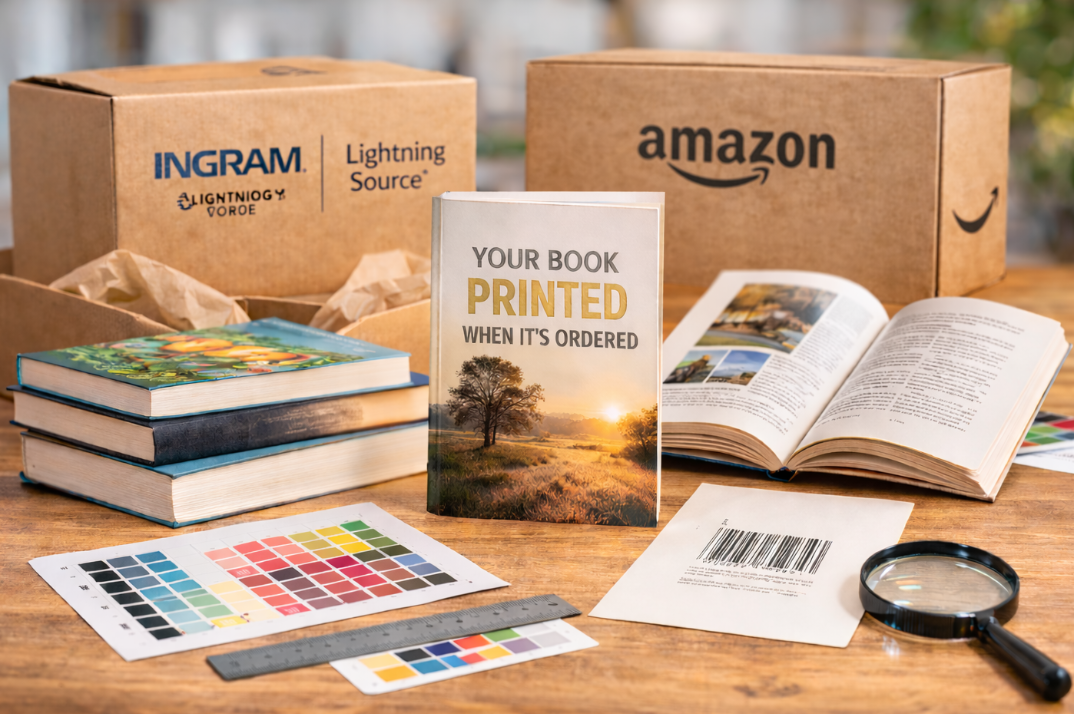
Print-on-demand means your book is only printed when there's demand, i.e. a copy has sold. This modern method of printing is a brilliant option for self-publishers. It completely removes the need for upfront investment in big print runs or warehousing costs for lots of books. Instead, each time a book is ordered, it's simply printed and shipped to the buyer. How clever is that!
POD does have limitations
There are some trade-offs for this convenience. For most customers these aren't an issue, but it is important to be aware of them all the same.
Firstly, POD printers work with a fixed set of trim sizes, papers, bindings and color options. Now, the set they use is chosen for a reason. They're the most sensible and common options. So unless you're trying to produce something very unusual, this is unlikely to be a problem.
Occasionally a book interior is designed around something very specific, like fancy endpapers, a pull-out map or colored edging. For covers, it's perhaps even more common for people to like the idea of gold foil lettering, embossed areas or spots of glossy UV. But unless you're printing books in bulk, it's just not cost-effective to do any of this. So POD doesn't provide these as options.
Then there's price. Printing large print runs can mean huge upfront investment and storage costs. But if you follow that route, each individual copy will be cheaper to print. This is just economies of scale. Printing one book at a time will always cost more per copy than printing hundreds or thousands of identical books in one big batch. But by going the POD route, you don't need to take the risk that half of them never sell.
Small variations are normal
While we're at it, there's one more expectation to set for POD. Small variations from one copy to another are completely normal and accepted. As each book is printed and finished individually, tiny differences in things like trimming, spine position or color density are just par for the course.
That said, a shift of a millimeter can feel big when it's your own book and you're inspecting it closely. So it's important to appreciate that this sort of movement falls well within standard commercial printing tolerances. Digitally printed books are so commonplace now that most readers wouldn't think twice about it. These tiny variations are simply part of what people are used to. Which is good because, within limits, they are unavoidable.
Occasionally there are also genuine imperfections. This can be a faint white line, a small cover scratch, a lamination smudge, slightly wavy pages or a tiny ink spot. Most are cosmetic and trivial, but for something bigger, send us a clear photo and we'll have it handled. Please include the final page with the barcode too. This helps identify the production batch.
The key thing is not to compare a POD book with one that's been mass produced. If you're using POD, these small variations are simply part of the process.
Print colors are not screen colors
This catches people out all the time. Your screen creates color with RGB light, but books are printed in CMYK, cyan, magenta, yellow and black ink. These are two very different ways of creating color, so what you see on a screen can never be a proper preview of what ink might look like on paper.
Super bright colors tend to show the biggest difference. In particular, vivid and luminous blue on a monitor will look darker and more muted in print. This is just a reality of commercial printing that we need to take into account when preparing your design files.
POD files need extra blank pages
You may find a blank page in your printed book that wasn't part of your manuscript. This is because POD printers work with fixed page blocks, often multiples of 4. So they may need to add blank pages to make the final page count work properly for printing and binding.
They also need one completely blank page at the back for the printer's own information and barcode to go on. This can look a bit strange if you're not expecting it. But the two barcodes are scanned during manufacture to match each interior with the correct cover as a pair.
The difference between Ingram and Amazon KDP
The two big names in print-on-demand are Ingram and Amazon KDP. We use both for publishing customers. Between them they have printing facilities in different parts of the world, including the US, UK and Australia. The idea is that when someone orders a book, it's printed as close to the customer as possible rather than coming from one central warehouse.
The two printers do similar jobs but are not identical. Some Ingram trim sizes or finishes are not offered by Amazon. And the same cover can look quite different just depending on the equipment that produced it.
So when we set a book up, we carefully opt for specifications that work happily across both printers. After all, there's not much point designing a book around something lovely that one printer can produce if the other one can't do it.
New printer means new files
You may eventually decide you want a separate print run in addition to your POD edition. That's no problem, just don't assume you can use the same files as they are.
Different printers use different paper thicknesses, bleed requirements, binding methods and cover templates. Even switching up the paper alters the width of the spine, which means a cover that fitted perfectly before now doesn't.
And if your POD edition uses a Wordzworth ISBN, that will need to come off before another supplier produces its own edition.
We think print-on-demand is pretty brilliant. It has made publishing a book possible for so many authors across the globe. No giant print runs, no storage, no risk. There are just a few important quirks to understand along the way.
But getting everything set up correctly, checking proofs and preparing the files for Ingram and Amazon KDP is exactly what we do. See our book publishing services for much more.