
Do you use AI in book design?
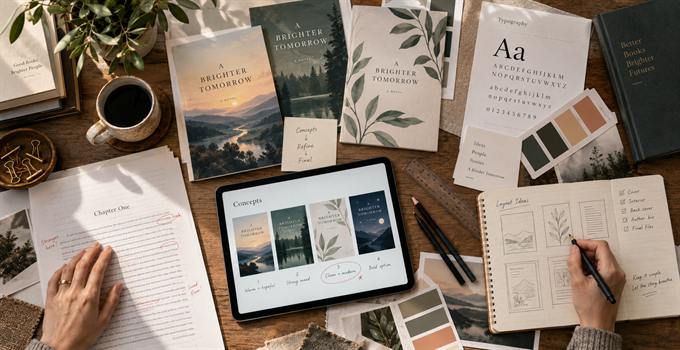
Yes, we do. We use AI where it genuinely helps us do better work, just as we use InDesign, Photoshop, image libraries, our own software and all the other tools that have become part of making books professionally. We do not use it automatically for everything, because it is not the best tool for everything. But where it can improve the result, speed something up or give us more room to explore an idea, we absolutely use it.
We have been designing and producing books for around twenty years, and the tools have changed constantly in that time. AI is a particularly powerful addition, but the principle is not new. Good tools make experienced people more capable.
We have always used technology to make better books
Book production looked very different when we started. Printing changed. InDesign and Photoshop changed. Huge image libraries became available. Drawing tablets changed the way artwork could be worked on digitally. The software authors write in evolved, and over the years we have built our own small tools to automate jobs that did not need a person doing them line by line.
We took advantage of all of those things because they made the work quicker, more accurate or simply opened up possibilities we did not have before. AI belongs in that same toolkit.
That does not mean every new tool replaces the old ones. We still use professional layout software, licensed fonts, printer templates, image editing software and all the other things a particular job needs. The useful question is not whether something uses AI. It is whether it is the right tool for the job.
AI gives us much more room to explore
One of the biggest gains is how quickly we can now try ideas.
Cover design is a good example. In the past, exploring several completely different visual directions could mean hours of finding stock images, compositing them, changing colors and building each idea far enough to judge whether it worked. That naturally encouraged you to settle on a direction fairly early.
AI lets us explore much more freely. We can test a setting, mood or composition, discard what is not working and take the promising ideas further. The author may never need to see most of those experiments, but the finished cover can be better because we had the freedom to make them.
The same principle applies elsewhere. If a tool can take care of a repetitive part of the process, our time can go into reading, designing, checking and making the decisions that actually need our attention.
We use the tool that suits the job
Not everything that can be automated needs AI. We have our own tools for parts of manuscript preparation, professional software for typesetting, image software for detailed artwork and automated preflight checks for print files. AI joins those tools rather than replacing them all.
That matters because different jobs need different kinds of control. A generated image might be useful while developing a cover, but the title still needs to be set properly in a licensed font. A print cover still needs an exact spine, bleed and trim. A long book still needs to remain consistent across hundreds of editable pages. A printer still expects a properly prepared PDF.
Part of doing the job well is knowing which tool will help and when another one will do it better.
The real advantage comes from knowing how to use it
AI is widely available, so it is perfectly reasonable to wonder whether you could simply use the same tools yourself. Of course you can. Many authors now use AI somewhere in writing, planning, artwork or publishing their books, and some will want to do a great deal of the production themselves.
What professional experience adds is not access to a secret piece of software. It is knowing what to ask for, what a good result should look like and when something that seems perfectly convincing is actually wrong.
That might mean knowing that a cover needs to work at thumbnail size as well as full size, that an RGB image will behave differently when prepared for CMYK print, that a margin will feel tighter after binding, or that changing the paper or page count will change the width of a spine. It might simply mean looking at an AI suggestion and knowing there is a much better direction worth trying.
The tool can give you an answer. Experience helps you know whether it is the right answer.
Better tools do not remove the need for judgement
This is probably the part of AI that interests us most. As the tools get better, they let us spend less time on execution for its own sake and more time considering what would make the book better.
That does not mean pressing a button and accepting whatever comes back. Quite the opposite. Having more possibilities means making more choices. On a cover we may try several visual directions before settling on one. In a layout we may test different ways of handling complicated material. Something generated quickly may become the starting point for a lot of more conventional design work.
The speed is useful because it gives us more room to think, not because it removes the thinking.
We are straightforward about the tools we use
We know that people have different views about generative AI, and some feel very strongly about it. Our approach is simply to be open about how we work.
We are a technology driven business and always have been. We use AI where we think it genuinely helps us produce better work, and we use other tools where they are better suited. We would rather choose the best way to make a book than follow a rule that says a particular technology must either be used everywhere or avoided everywhere.
If you ask us whether we use AI, the answer is therefore an uncomplicated yes. It is one of the tools available to us, and a very useful one.
So, do we use AI?
Yes. We use AI where it makes sense, alongside the professional design, publishing and print tools we have used and developed over the last twenty years. It has made some parts of our work faster, given us much more freedom to explore ideas and expanded what we can offer authors.
What has not changed is who is responsible for the result. The tools do not decide what your book should become. We do. We choose which tools to use, direct them, check their work and bring everything together into the finished book.
That has really been our approach to technology for twenty years. Use the best tools available, keep the parts that genuinely improve the work, and put them in the hands of people who know what a good book looks like.
If you would like us to put that experience to work on your book, you can see everything we offer through our book design and self-publishing services.