
Book pricing guide
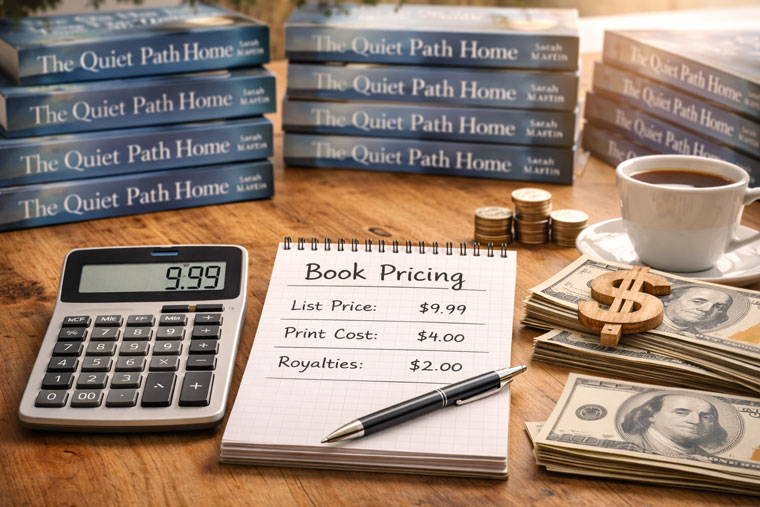
One of the advantages of self-publishing is that you get to choose the price of your own book. Because you're in charge here, right down to your book price and profits.
But it's not an easy decision. Especially as pricing is far from an exact science. It revolves around a lot of somewhat arbitrary values, and it's one decision that particularly seems to flummox authors.
Make your book too expensive and you won't sell many copies. Make it too cheap, and even if books fly off the shelves you'll hardly cover production costs. Neither extreme works. It's a careful balance.
Once your book is ready for distribution, you'll be asked to go to the Authorzone and set your list price. These next few sections explain how list price, wholesale discount and print cost work together. Hopefully they'll help you understand how to choose a price that feels right for your book.
Setting your list price
The list price is the amount your readers will pay to purchase your book. You might also see it called the recommended retail price, book price, or sticker price.
Books with a higher list price can exude a superior, high-quality image, but fewer people may be willing or able to buy them. Books with a low list price, on the other hand, may be more affordable, but readers may also assume they're poor quality and not worth their time.
You'll need to do some research, comparing like for like, to see what readers have been willing to pay in the past. Don't go comparing your text-heavy paperback to a full color illustrated hardback, for example. Look for books of similar production quality, size and page count, and try to focus on your topic area or genre. No reader is going to pay twice the price for your book if there's a similar book sat right next to it on the shelf.
For our example book, The Quiet Path Home, let us imagine a starting list price of $10.00.
Understanding wholesale discount
Retailers buy your book at a discount. They get it for what's known as the wholesale price. This way they can stock and promote books but still make a profit.
Typical wholesale discount is around 40%. Too low, and a retailer won't want to stock your book, even Amazon can show it as 'unavailable'. Too high and you won't cover production costs, let alone make a profit.
List price: $10.00
Wholesale discount: 40%
Wholesale price: $6.00
What is print cost
To make a profit, you need to sell each copy of your book for more than it costs to print. Obvious, right?
Every printed copy has a manufacturing cost. This is based on trim size, page count, paper choice and whether the interior is grayscale or color. So you do need to fix these choices before your printer confirms a price per unit. If you order a lot of copies, this will impact things too, big print runs lower the unit cost.
Don't worry about postage costs though, your book buyer pays for these.
Have a play with our print cost calculator. The difference between your wholesale price and print cost becomes your royalty, which you can work out at any price with our royalties calculator.
Print cost: $4.00
Royalties: $6.00 - $4.00 = $2.00 per copy sold.
Pricing in different regions
You need to set a list price for each market where your book is sold. If your main price is USD, your book will need prices for other territories like the UK, Europe and Australia. Print costs do vary between countries, so don't expect your royalties to match everywhere. That is just the nature of selling across borders.
If your main USD price is $10.00 USD, equivalent list prices might be:
United Kingdom: £7.99 GBP
Europe: €8.99 EUR
Australia: $14.99 AUD
These are only illustrative and obviously depend on the current exchange rate.
Ending prices in .99
You can pick any number you like but it's good to know the conventions. Retailers tend to list books ending in .99, it aligns your book with others on the shelf and is familiar for customers. Don't just pick a weird number out of the air like $11.73, it's confusing.
$10.00 becomes $9.99
Don't panic. We're doing this now so you can get it right, better to put the work in now than guess at a list price and have to change it once it's on sale.
If you're not happy with your potential profits, now's the time to change a number in your equation. Could you reduce your production costs somehow? Maybe lower your wholesale discount? Or do you think your customers might be prepared to pay a little more for the list price? Just keep playing around with the numbers until you land on royalties you're happy with. You're hunting for that magic sweet spot where the whole process harmonizes.
And don't forget, we're here. We're always happy to talk through your options and help you sense-check your pricing. Pricing sits alongside the distribution and setup covered by our book publishing services.